Okay, I am currently very busy, and so I will not be able to post any more reviews of Grimm for a while. It's time I get back to dinosaurs.
So, while I am late for this, the post will cover how the media can turn a cool discovery into a mess.
So, earlier this month, the news that scientists found out the colour of extinct marine reptiles broke, and I was immediately excited at that finding. While I may be over exaggerating, it may be possible to find out the colour of most dinosaurs, not just feathered ones, but I don't have a degree so it's just wishful thinking on my part.
A cool discovery, but there has been one little thing that nagged me all this time. A line I noticed from many press releases, including one by live science. It basically says "ancient marine reptiles where ALL black." ALL. Really? As far as I know, the scientists studied an ichthyosaur, some mosasaurs, and an extinct leatherback turtle. So, based off of these three data sets, all Mesozoic marine reptiles where black. Who's fault is it? It is the scientists? Or the media?
My finger is firmly pointed at the media. I've never been a big fan of media reporting in general, but I particularly dislike their science reporting. Before I bash, I do know there are some good science reporters who do an excellent job at reporting. But many news sources have unfortunately fired their science reporters and instead have Bob who does the gardening section to cover the Higs-Boson.
I's just the way that media works now, wether you like it or not. It's no longer about reporting information, it's about making press releases.
It isn't just press releases on this story that made me angry. What made me real angry was some of the reporting that "Most dinosaurs weren't feathered", which I still am skeptical of.
One of the headlines was "Feathered dinosaurs? For your dreams only." That made me both interested and greatly frustrated. Now from the headline, by the Free Press Journal, it seems like that feathered dinosaurs never existed. What the hell are they talking about?! It's only when you read it that you actually understand what they are talking about.
On a quick side note, I will say that the feathered dinosaur press releases said that Triceratops was scaly, when in fact, an as of yet undescribed Triceratops was found with skin impressions, and clear impressions of quill like structures on them. That is just my pedantic aside.
In the end, I wish that we couldn't have such sensationalistic headlines like "OMFG, WE WHERE WRONG ABOUT FEATHERED DINOSAURS!" But in the end, that's just my pedantic nature.
Showing posts with label Dinosaurs. Show all posts
Showing posts with label Dinosaurs. Show all posts
Saturday, January 25, 2014

Saturday, December 14, 2013
Rise of the Obscure Species, Part 2
Last time, I brought you many wonders of the obscurity world. Acrophoca, Arctotherium, Inostrancevia uralensis, Ichthyovenator, Lythronax, Dinofelis, Xenosmilus, and a few more. Now, I will continue with more obscure species that have yet to receive the light they deserve. This post, I will focus more on Mesozoic animals, mostly dinosaurs. Some have never been restored, others, have a unique restoration. All illustrations where kindly provided by Yutyrannus form the Dinosaur Toy Forum,who did them as soon as he could. Thanks!


The new name for an old friend.
We all remember him. Acheroraptor was the name recently given to the Hell Creek dromaeosaurid. At first, there was no evidence droameosaurids lived with Tyrannosaurus, but now there is irrefutable evidence. I have nothing to say except that the illustrator based the colours off of the Guam Rail, a very cool bird. It is flightless and as of now extinct in the wild.

Antarctotitan
Jurassic Antarctica has been the new frontier in paleontology for me. It was populated by some pretty awesome dinosaurs, one of which, Cryolophosaurus, is one of the most complete Antarctic dinosaurs yet found. Another group of dinosaurs that lived there where the sauropods. You may be familiar to the primitive bipedal sauropod, Glacialisaurus, but there is also another, quite large sauropod from there. It has no formal name, and so the name I identify it as, is not the actual name. For now, I call it, Antarctotitan. Antarctotitan is not new to paleontology. It has been known from almost decade, but I haven't seen a restoration of it. Since there is no published skeletal of the dinosaur available, we have to look at relatives. In this case, the artist used Malawisaurus as a reference. Even though it is a Cretaceous titanosaur, I think of it as a good reference. I especially like the red head. I'm sure sauropods where not all dull coloured.

Australian spinosaur
I have another obscure animal from the South Pole, only it's from the Cretaceous and from Australia. For namesake, I'll call it Australospinas. It has no formal name yet, but we'll call it that. Australospinas has been known for a few years, and only from vertebrae and a few other bones. It is mostly based on Baryonyx, but here it is featured as iridescent, even though it isn't seen in the picture. This is the second restoration of Australospinas I have seen, and I am surprised I haven't seen more.

Bradycneme
Alverazsaurs are cool. They have the most interesting hands of any theropod. A very short arm, almost the mini-tyrannosaurs, except not as ferocious, but it only has one functional finger and claw. It has since been speculated that they hunted colonial insects, such as termites, or ants. Above is one of the rare alverazsaurs that only people like me and paleontologists know about. You may remember in the 2011 BBC documentary, Planet Dinosaur, depicted Bradycneme has a troodontid. However, it was recently classified as an alverazsaur. It should be noted that Bradycneme is known from very fragmentary remains, so it could be a troodontid. The one thing I like about this restoration is that it isn't shrink wrapped, with long feathers all over its body, and the hoatzin like head.

Melanorosaurus
One thing I am surprised to see is dinosaurs that have speculative soft-tissue that doesn't really fossilize, as I am sure that just like birds, they have bizarre fleshy structures used for mating that you wouldn't expect for it to have by looking at the skeletons. This seldom seen dinosaur above, Melanorosaurus, has a small red dewlap, used for attracting mates. It is unsure wether or not it had it, but I wouldn't be surprised if it had it. Relatives like Diplodocus get more attention, because they are larger than their early ancestors, but relatives like this are also very cool.

Zalambdalestes
For all of this post, we have been talking about dinosaurs, but we will end with a very cute and tiny Mesozoic mammal, Zalambdalestes. They were like the elephant shrews of the Cretaceous. They may have lived in underground burrows, and ate small insects. Overall, it was a perfect example of the typical Mesozoic mammal, and you would be seeing a lot of mammals looking like Zalambdalestes, although not all mammals where small and shrew-like. The Zalambdalestes in the picture above, is also albino, something so rare, I wish it was depicted more often. The only other piece I've seen features an albino Microraptor.
Overall, these animals are considerably more obscure than my first obscure species post, two of them don't even have formal names. This is not the last post on Obscure Species. I will have many more, and soon, an entire army of Obscurities will dominate this blog.
Tuesday, November 26, 2013
Old Friend, New Name

Well, we've known the existence of dromaeosaurids from the Hell Creek Formation from tooth fragments, but whether Dromaeosaurus lived alongside Tyrannosaurus or not was not proven yet. Not until know. These tooth fragments didn't belong to Dromaeosaurus, but it was for sure a dromaeosaurid. Now, we finally have conclusive proof, that dromaeosaurids lived alongside the King of Dinosaurs. Meet, Acheroraptor temertyorum, the geologically youngster dromaeosaurid to date. Bizarre thing I realized. Dromaeosaurus is a dromaeosaurinae, (well, duh) but Acheroraptor was a velociraptorinae. This still means that dromaeosaurinae's did not live with the King, but hey, at least we got velociraptorinae's living with him.
So, I think this finally proves the depiction in Walking with Dinosaurs (TV Series) of dromaeosaurids living with Tyrannosaurus. However, instead of the bulky Deinonychus like skull, it had a more Velociraptor like skull, because it was a velociraptorinae.
I should mention, that my obscure species post will be the first of many, and the next ones will feature many new guys, including Zalambdalestes, Acheroraptor, and the unnamed Antarctic Sauropod (which I will identify for namesake as Antarctotitan), and the unnamed Australian spinosaurs (for namesake, Australospinas).
Saturday, November 23, 2013
Gorgosaurus
Time for my second Walking with Dinosaurs dinosaur review (the children's version, not the TV) and this time it's my third favourite Arctic dinosaur after Parksosaurus and the Alaskan Troodon. Gorgosaurus.


Gorgon
The Gorgosaurus in the movie is a beautiful iridescent blue, with white and black marking on its skull. I will first say before I go on, is that iridescent blue is unlikely for such a large predator. However, it could be seasonal, or it didn't need to be dull coloured to blend in. To be honest, this is not as big as a deal as another part of the design that I will talk about later.
The design of the Gorgosaurus seems to be very accurate, and the fact that we have Gorgosaurus instead of Tyrannosaurus on the big screen makes me want to smile. As I've stated before, I don't have such high hopes for the film, but the earplugs will hopefully make me enjoy what I wanted: silent dinosaur film.
One of my biggest problems with the model is the integument. The Gorgosaurus in this movie are scaly. While it does look like what we always thought tyrannosaurs look like, recent new fossil discoveries show that even big tyrannosaurs can be feathered. In 2011, 3 specimens of the Chinese giant feathered tyrannosaurs, Yutyrannys huali, where found, but they weren't described until 2012. However, I can slightly forgive the scaly Gorgosaurus in the movie, because the models where made in 2010, a year before Yutyrannus was discovered, and a full two years before it was formally described and released to the public.
Many people use the discovery of Yutyrannus to argue that giant tyrannosaurs, specifically Tarbosaurus and Tyrannosaurus where fully feathered. Some argue that these animals lived in a much warmer environment than Yutyrannus. Yutyrannus may have experienced snow. Tyrannosaurus didn't, so for now, I am unsure if Tyrannosaurus was scaly or feathered, but I hope for it to be feathered because that would be more interesting. However, with Gorgosaurus it is different. It is around the same size as Yutyrannus, and lived in a much colder place than Yutyrannus did. Four months of darkness and freezing cold every winter. Therefore, it seems that Gorgosaurus was more likely to have feathers. It should be noted that impressions of scales on the base of Gorgosaurus' tail have been found, but it is possible that other parts of it's body are feathered, or that the tail was covered in feathers, but the type of preservation didn't preserve feathers. Also, it seems like the film makers thought that scaly tyrannosaurs would be more recognizable to the audience.
I give this Gorgosaurus a 8/10.
In the end, I think if the Gorgosaurus won't talk, he will be my favourite character in the entire film. And below, is what the movie tyrannosaur could have been. Until next time.
Tuesday, November 19, 2013
The Rise of Obscure Prehistoric Animals
This post is about obscure species of the past. They are rarely represented in paleoart and deserve to get more attention. Animals like Smilodon, the woolly mammoth, Triceratops, and Tyrannosaurus, all, are in the way of people knowing about these fantastic animals.




Acrophoca lonairostris
Our first creature, is Acrophoca. I never even knew this animal existed until about two months ago. Acrophoca is an ancestor to the modern day leopard seal, but unlike leopard seals, they lived in the waters around Peru or Argentina, have claws on their flippers, and ate fish, instead of penguins. They lack the canines that grip and tear up penguins, but have the teeth for noming on fish. Overall, the restoration above it similar to the only skeletal of this animal, and gives it brown fur, unlike the few restorations that have leopard seal patterning. Overall, a unique and beautiful Pliocene pinniped.

Arctotherium augistidens
We are now moving on to the pinnipeds closest living relative, bears. Above is one of the very few reconstructions of a contender for the largest carnivorous land mammal on Earth. Arctotherium, the South American Short Faced Bear. The short faced bears are all but extinct today, the only relative being the speckled bear in South America. Bears are not native to South America, but around the start of the Pleistocene, a land bridge formed, allowing animals from North and South America to invade either area. One of the North American migrants where the short faced bears.
Above, you are looking at Arctotherium. It is thought to be weighing close to a tonne, and be 3 meters long. This alone makes it bigger than Arctodus, its North American cousin. Why it got so big is still a mystery, but the restoration above is on the few (sadly) of this animal, and really shows just how robust they were.

Dinofelis pivetaui
When thinking about Cenozoic carnivorous mammals, you just can't forget one very deadly one. The Machairodonts, or the sabre-toothed cats. The most famous is Smilodon fatalis, from North America of the Pleistocene, but many are left in the dark and often not known. Another moderately well known Machairodont is Dinofelis, which got its popularity thanks the the fantastic Walking with Beasts. However, in most restorations, this cat is depicted robust, like in WWB, and also a similar pattern. This type of art is very common in the paleoart community, and it wasn't until All Yesterdays that we managed to finally think outside the box. Above, I would categorize this as All Yesterdays. Instead of the robust WWB Dinofelis we all know, we have a cheetah like Dinofelis. While I think Dinofelis was not as fast as a cheetha, it was certainly deadlier. With its small but incredibly dangerous sabre-teeth, there is no way an early hominid could survive a bite to the head, from this predator.

Ichthyovenator laosensis
We recently learned of the discovery of Ichthyovenator, the most appropriately named spinosaur to date, and its bizarre sail. I will say one thing. I think a skin membrane or a fat storing area would fill the gap between the sails, but this is speculation and has nothing to do with the illustration above. The pose and basic build of the animal is based off of Scott Hartmans Suchomimus skeletal, and it is possible that Ichthyovenator was closely related to Suchomimus. However, this animal is restored in a way that I haven't seen before. It isn't shrink wrapped! The animal actually looks like something that can swim and catch prey with his arms, and use its tail to help swim through the swamps of Cretaceous Laos, and this should be depicted more often.

I don't need to explain
Recently, we learned about HIS existence, but I won't rehash that. Instead, I'll talk about a unique way the artist depicted him above. I learned that the artist was trying to portray Lythronax as a scavenger. In my blog post, I stated that someone was not to far off saying that it was a scavenger. However, I don't find it infuriating. I find this theory intresting, and it is possible that Lythronax was part of a group of tyrannosaurs that scavenged, rather than hunting.

Inostrancevia uralensis
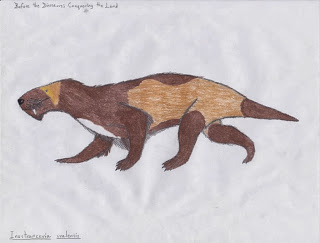
I love this restoration. I am in deep love with it. When we see Inostrancevia, we also see the most well known species, I. alexandri. Instead, we have I. uralensis. I haven't seen another restoration of this species ( may have missed something) and it's good to see it instead of another I. alexandri. It is also good to see a rare restoration of a rarely depicted Inostrancevia species in a rare way. The colours are based off of wolverines, and it has fur all over its body. This shows the reptiles relationship to mammals. It has long fur on its belly and arms, something I've never seen before. It also has whiskers, something rarely depicted too, and it even has a mammal like nose. It may be that gorgonopsids where not covered in fur, but maybe they where. I speculate that while they lay eggs, they may have suckled their young. However, that is my theory, and has nothing to do with the rare restoration of a rare species of Inostrancevia.

Xenosmilus hodsonae
I will end my longest blog post on another rarely depicted Machairodont, Xenosmilus. It has the look of a tiger, but more robust, with a shorter tail, and longer canines. I should also note that while the artist was making it, he let people suggest what pattern and colour it should be. I suggested the golden tiger (a very rare breed of tiger) and he went with it.
I have to thank Yutyrannus from the Dinosaur Toy Forum for letting me use his artwork as I ramble on about the fantastically obscure species he chose to restorate. Until next time, have a great day!
Wednesday, November 13, 2013
All Hail the King of Gore
And thank you Scott Hartman for inspiring my blog title.
Yes,, Lythronax has been all the rage lately. Not only does it have importance in tyrannosaur evolution, its name is also insanely awesome. King of gore? Look out Tyrannosaurus!

In 2009, in the Wahweap Formation, the first fossils of Lythronax where found. It consisted of a partial skeleton, including a skull, which is also terrifying. It had good vision, with depth perception, and a massively powerful bite you do not want to be given if you piss it off. Its teeth are quite beefy, with a serrated edge like that of a steak knife. Clearly, this animal could not only slice through meat, muscle, and tissue, but also could crush bone.
Which makes me raise an question that I haven't seen (or noticed) yet. Will someone turn this around and say that because its teeth could crush bone it was a scavenger? I bet you someone has, but I haven't noticed it yet. Bone crunching teeth isn't really a sign of a scavenger, because while hyenas crush bone, they will also hunt in packs and take down a wildebeest. However, whether it was a scavenger or not, when it ate, guts would be spilling all over the place.
Another interesting thing about Lythronax, is that it is currently the oldest known tyrannosaurinae, dating to about 80 to 79 million years old. So, it seems that bone crunching gore lovers where present before the reign of Tyrannosaurus, which isn't that surprising.
I have also noticed that some articles on this animal say it was feathered. While it is not unreasonable to be feathered (I think it is feathered) I couldn't find any evidence to suggest it was feathered. While it is likely to be feathered, there is still no feathers, and I consider this misleading.

Yes,, Lythronax has been all the rage lately. Not only does it have importance in tyrannosaur evolution, its name is also insanely awesome. King of gore? Look out Tyrannosaurus!

In 2009, in the Wahweap Formation, the first fossils of Lythronax where found. It consisted of a partial skeleton, including a skull, which is also terrifying. It had good vision, with depth perception, and a massively powerful bite you do not want to be given if you piss it off. Its teeth are quite beefy, with a serrated edge like that of a steak knife. Clearly, this animal could not only slice through meat, muscle, and tissue, but also could crush bone.
Which makes me raise an question that I haven't seen (or noticed) yet. Will someone turn this around and say that because its teeth could crush bone it was a scavenger? I bet you someone has, but I haven't noticed it yet. Bone crunching teeth isn't really a sign of a scavenger, because while hyenas crush bone, they will also hunt in packs and take down a wildebeest. However, whether it was a scavenger or not, when it ate, guts would be spilling all over the place.
Another interesting thing about Lythronax, is that it is currently the oldest known tyrannosaurinae, dating to about 80 to 79 million years old. So, it seems that bone crunching gore lovers where present before the reign of Tyrannosaurus, which isn't that surprising.
I have also noticed that some articles on this animal say it was feathered. While it is not unreasonable to be feathered (I think it is feathered) I couldn't find any evidence to suggest it was feathered. While it is likely to be feathered, there is still no feathers, and I consider this misleading.

Teratophoneus crashes Lythronax's birthday party. Thanks to Julio Lacerda for letting me use this picture for this post.
In other tyrant news, more Teratophoneus material was found. Apparently the skull is a little, narrower, and also is certified as the most terrifying predator, as its tearing out intestines from its hapless, unnamed victim. Oh, wait, Lythronax is supposed too.... never mind me.
So, you get a post about two tyrannosaurs, Teratophoneus and Lythronax, for the price one! Have a bloody good day!
New Walking with Dinosaurs Japanese Trailer
A new trailer for Walking with Dinosaurs has been released, and is available on Youtube. It is such a shame that it looks so awesome, but the fact that there will be voices just makes me angry. I am for sure buying ear plugs. And of course, they could have done Gorgosaurus with feathers, but I will justify this since Yutyrannus existance was not known at the time the models where made.
It is a real shame that they had to do this, but I guess we don't get what we want. Let's just hope this is successful enough to warrant a sequel that won't be like this.
Here is where to go to see the trailer. Intense, but just childish. I apologize for being such a pendant, but I guess they've missed what could have been an awesome movie. I'll just pop in the original series this weekend and eat a bowl of ice cream, and I'll be all set.
It is a real shame that they had to do this, but I guess we don't get what we want. Let's just hope this is successful enough to warrant a sequel that won't be like this.
Here is where to go to see the trailer. Intense, but just childish. I apologize for being such a pendant, but I guess they've missed what could have been an awesome movie. I'll just pop in the original series this weekend and eat a bowl of ice cream, and I'll be all set.
Monday, November 11, 2013
The New Deinocheirus

A pair of sunbathing Deinocheirus. Thanks to Joschua Knuppe for letting me use his artwork for this post.
So, I am going to talk about the new material from Deinocheirus. It has long since been a mystery of what these gigantic arms where attached to, but it's a mystery no more.
On July 9th, 1965, Polish Paleontologist Professor Zofia Kielan-Jaworowska and her team found a few ribs, some vertebrae, and a massive pair of arms. These arms where over 3 meters long, and they where certainly from a very large theropod. But what kind? Some thought they where from a giant ornithomimosaur, others thought they where from a gigantic flesh eating theropod, that used its massive arms to rip open the stomachs of sauropods.

What the hell is that?
However, soon a consensus came in. It was thought to be an ornithomimosaur, albeit a very large one. But what the rest of it looked like was only guess work. By studying relatives of it, many came to the conclusion of what it looked like.

This is what it looked like then.
Above, you see the picture of the Deinocheirus toy in the CollectA line. It seemed pretty much like a gigantic oversized Gallimimus. Well, it wasn't.
Finally, after nearly 48 years of mystery, the fog of time has cleared with new fossils. It turns out, Deinocheirus was weirder than anyone could have imagined. It had a sail on its back! And it had a robust look, not normal for the usually gracile smooth backed ornithomimosaurs. The most incredible thing for me is the sail. It is something that I never thought would come out from the ground. A sailed-backed coelurosaur?
All known sail backed dinosaurs (Spinosaurus, Ouranosaurus, ect.) have all been non-coelurosaurs. This makes Deinocheirus the first known Coelurosaur with a sail on its back. A skull was also found in the new remains, but unluckily, poachers stole the skull. Lets hope that we can either retrieve that stolen skull, or find a new one, and maybe it's skull would fit the new bizarre look of Deinocheirus.
Overall, this is one of most exciting finds in my so far short lifetime, solving a nearly 50 year-old mystery. However, with the skull still missing, its complete appearance is still a mystery, and so the hunt for the mystery dinosaur, continues.
I would like to thank Joschua Knuppe again, for letting me use his Deinocheirus restoration for this article. And, for the readers, have a great day!
Sunday, November 10, 2013
Troodon

I am going to start by saying I like this design. I like how the design in hoatzin like, with blue around the eye, and the feathers sprouting from the back of its head. I like how the designer didn't just make a Troodon with feathers, but a Troodon that feathers it may not have had. I also like that it has tiny feathers similar to its wing on its back leg, maybe it was derived by a gliding ancestor of its. I also like that the feathers go past the ankles, not that it is more realistic, it's just that I like that style better for some reason. It also doesn't look shrink-wrapped, which is good, and gives it a more realistic appearance.
That's the good part. Now I am going to talk about the negatives. And theres more negatives than I wanted there to be. While the feathers look good in the picture above, in the trailer it doesn't look that good, as if it where super-glued on.

Like that picture.
However, it could be the pose the animal is in, but I'll just leave it at that. Now lets talk about the scaley lizard face. There are fossils of troodonts with feathered faces, and while we haven't found feathers on Troodon yet, given it position in the dinosaur family tree, it certainly had feathers, and if it did have feathers, it is unlikely it had a scaly lizard face. It is more likely it had a feathered face, or an unfeathered (and unscaled) face. However, since we will never see them, we may never know. Also, the scaly face was probably artistic license, giving the animal a villainous look. Obviously its the villain because it punches a hole in Patchi's frill when he was little. However, apart from the scaly face, I think he looks cute.
Another problem I am having with the animal is its wings. I am very happy they have wings, but it seem like the primaries are.... off. The primaries should be on the second finger, and based on the first picture, it seems like the primaries are sort of attached to it. I guess I'll give that a pass.
However, a little thing I've noticed (I'm not sure if anyone else has) is the shape of the skull. The skull has a little bump on the top of the skull, something I have not seen in Troodon skulls before. It is also ambiguous about what species of Troodon they are portraying. The movie is set in Alaska, and teeth of 4 meter long Troodon have been found there, but if they are the species seen in the movie or not is unclear. If they are, then I'll let that pass because it may have looked slightly different from its relatives. After all it was larger.
So the Troodon has an overall great appearance, but the head is the biggest issue, with the bump and being scaly.
As I do these reviews on the animals in Walking with Dinosaurs, I will score them based on my opinion and accuracy. I do have to say before I move on, I am not a paleontologist, but I think I know enough to look out for inaccuracies.
In total I give the Troodon a 9 on the accuracy scale, as it portrays a somewhat non-shrink wrapped feathered animal, and for having the primaries barely on the second finger, and a scaly face.
Watch out for more reviews, and if I got anything wrong, you can correct me and I'll update the post. Until tomorrow.
Saturday, November 9, 2013
Walking with Dinosaurs: The Movie

In 1999 the BBC aired a fantastic series, Walking with Dinosaurs. A six part programme with half hour episodes. It made you feel immersed in the past, and even if the animation and CGI was a bit off, the narration kept you on track. This programme inspired me to become insanely interested in special effects and television production, but of course, I was more inspired to become interested in dinosaurs, my biggest interest of the three topics I just mentioned.
That begin said, next month, the movie based off the series will come to theatres. And now this is where things go downhill from here.
We've known that a movie was in the making ever since November of 2010. So I've been waiting for this epic movie for three years. Even though It hasn't come out yet, this movie just destroyed my childhood. It is hard to believe this movie was even made by BBC Earth. It looks like a freaking Disney film!
On the positives: I am glad obscure species are finally getting well deserved screen time. We have Alexornis, Hesperonychus, Alphadon, Edmontonia, and Chirostenotes get their first on screen appearances! Also, we have feathered dinosaurs in cinemas! It looks like to be the most accurate representation of these animals yet. (With the exception of scaly Gorgosaurus and scale faced Hesperonychus and Troodon)
But, it is not like the 1999 series at all. This is aimed at children, with actors voicing their thoughts, and names for the animals. This is what upset me. You spend nearly 65 million dollars, trying to make accurate animals, animate it, edit it ect. to make a movie that already exists. Its called Dinosaur. You can call this movie Dinosaur 2 as a matter in fact. I am glad children will be given awesomely realistic and accurate dinosaurs, but the fact that they turned this movie into an infintile-fest sickens me.
When the first trailer was released, I was really hyped. It wasn't like the BBC series, but it looked good. None of the dinosaurs had names, it looked like there was no narration. It was all good.
It looked like it was marketed to all ages. But the news that big names are voicing the dinosaurs is shattering my childhood more.
If they wanted talking dinosaurs, they could have done that. Instead, everything has been ruined by voices. It seems like they are afraid to try, afraid to try something different. Instead, they want money and they want to draw children in. I actually have no problem with that, but I have a problem with marketing it only to children. You don't need to have voice actors voicing the dinosaurs thoughts to make children watch it. My cousin is in love with dinosaurs, like me, and it doesn't matter if its a documentary or not, his eyes are glued to the screen when he sees those dinosaurs. The voices don't exist to them. Its just a distraction.
This is a warning for anyone who wants to make something like this again, don't add voices. You can just show these animals with a little Kenneth Branagh sprinkled here and there and people will love it even more.
I will still see this movie, but with low expectations, and ear plugs.
Subscribe to:
Posts (Atom)