I was going to do a full post on Spinosaurus, but now that there has been so much more controversy with the leg size, I am going to spend a lot more time on the post now. That being said I do have an opinion on this and when I return I am doing a very thorough review of evidence and I'll outline my conclusions. This could take a while, and even then I might change my mind if new evidence comes to light on the issue.
Did that make any sense? Well, short of it is, I will have a full post on Spinosaurus soon, and I was goong to post it today, but I thought twice, and it's best to spend more time. The next post will be on Spinosaurus, and my opinions (some of which are a little, well, not generally excepted by most people). Until then, wait...
Sunday, September 21, 2014

Saturday, August 23, 2014
Spinosaurus Is Weird
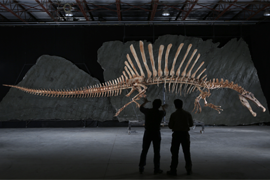
To counterbalance the heavy front end, it would need a massively long tail. So, it seems like it was more than just semi-aquatic. However, that leaves a burning question: how could it have walked? If its feet were tiny, how? was reading a discussion on the Dinosaur Toy Forum about this, and some people gave some suggestions of how. As said above, it could have had a long tail to counterbalance it. Another person gave the suggestion of maybe it splayed its legs slightly to spread its weight. I find the former more plausible, but the feet are small. However it did walk, it would look awkward, and otherworldly.
But, this is not really news. It has been online for about a year now, but for some reason finally became big this year. A few interesting things as well. Paul Sereno, who discovered the new remains, said that the above picture is inaccurate. So, that begs the question, what is inaccurate about it? Did its sail not have an impression? Were its feet actually normal sized? That we won't know, until the paper can be published. Until then, we will continue to speculate the habits of this remarkable creature.
Friday, August 15, 2014
The Leaellynasaura Theory
Out of all the times in Earth's history, the most interesting was the Cretaceous, second was the Permian. Out of all the countries in the Cretaceous, Australia was the most interesting. It is full of surprises, and animals that live nowhere else on Earth. And out of all those animals in Australia, one was adapted to the polar conditions, better than any in my opinion. My all time favourite dinosaurs; Leaellynasaura amcigraphica. This post is dedicated to my most interesting of ornithopods.

Leaellynasaura is known from little material, a skull and some tail vertebra. But we know a few interesting things from those isolated fossils. The skull housed a huge eye, and it was very useful for seeing in the dark, which would last up to five months, since Australia was connected to Antarctica. The tail is the defining feature of Leaellynasaura. It is three times longer than the head neck and body combined. So, what could it have been used for? Well, we need to look at the environment at the time. There were no polar ice caps in the Cretaceous, but the early Cretaceous did experience some cold temperatures, especially compared to the late Cretaceous, which was incredibly warm. Because of the presence of trees, that the climate was warmer than Antarctica today, but it wasn't implausible that it didn't snow of get below freezing. With this, we can speculate what the tail is used for. Because it's very long, we can imagine it being bushy, and so Leaellynasaura likely had feathers (Kulindadromeus). If the feathers didn't protect it from the cold, they could use their bushy tail to wrap around the body, and keep it warm. This is further supported by the fact that the tail was very, very flexible, and not stiff, easily capable of wrapping around its body. The tail may also have been used as a decoy. If a predator were to attack, they could make themselves bigger than they are by puffing up their tails. They could also use it in sacrifice to save its body. Confuse the predator to go for the tail, and not the body.
But the rest of the post is going to be my speculation on the rest of Leaellynasaura. We don't have a rest of the body, especially the arms and feet, so I am going to use wild speculation. I don't think it's implausible that little Leaellyn had wide feet to navigate through the snow. The feet wouldbe fully feathered of course, and be used like snowshoes. And it's legs would be the most powerful part of little Leaellyn's body. The arms may have been tiny, almost vestigial, with little use. Of course, we have no evidence for the second part, but sometimes Polar Animals evolve bizarre features for apparently no reason.
In the end, we may never know about little Leaellynasaura, but in the end, it really is the most interesting dinosaur of all. With the longest tail length in comparison of it's body of all dinosaurs, it surely will not be mistaken by the generic ornithopods.

Leaellynasaura is known from little material, a skull and some tail vertebra. But we know a few interesting things from those isolated fossils. The skull housed a huge eye, and it was very useful for seeing in the dark, which would last up to five months, since Australia was connected to Antarctica. The tail is the defining feature of Leaellynasaura. It is three times longer than the head neck and body combined. So, what could it have been used for? Well, we need to look at the environment at the time. There were no polar ice caps in the Cretaceous, but the early Cretaceous did experience some cold temperatures, especially compared to the late Cretaceous, which was incredibly warm. Because of the presence of trees, that the climate was warmer than Antarctica today, but it wasn't implausible that it didn't snow of get below freezing. With this, we can speculate what the tail is used for. Because it's very long, we can imagine it being bushy, and so Leaellynasaura likely had feathers (Kulindadromeus). If the feathers didn't protect it from the cold, they could use their bushy tail to wrap around the body, and keep it warm. This is further supported by the fact that the tail was very, very flexible, and not stiff, easily capable of wrapping around its body. The tail may also have been used as a decoy. If a predator were to attack, they could make themselves bigger than they are by puffing up their tails. They could also use it in sacrifice to save its body. Confuse the predator to go for the tail, and not the body.
But the rest of the post is going to be my speculation on the rest of Leaellynasaura. We don't have a rest of the body, especially the arms and feet, so I am going to use wild speculation. I don't think it's implausible that little Leaellyn had wide feet to navigate through the snow. The feet wouldbe fully feathered of course, and be used like snowshoes. And it's legs would be the most powerful part of little Leaellyn's body. The arms may have been tiny, almost vestigial, with little use. Of course, we have no evidence for the second part, but sometimes Polar Animals evolve bizarre features for apparently no reason.
In the end, we may never know about little Leaellynasaura, but in the end, it really is the most interesting dinosaur of all. With the longest tail length in comparison of it's body of all dinosaurs, it surely will not be mistaken by the generic ornithopods.
Monday, August 4, 2014
Kulindadromeus Changes the World
First off, I know I am late to this. Now, since last year, there was rumour of an ornithischian from Siberia with feathers. It was called "Kulindodromeus". Well, it is finally described, but is called "Kulindadromeus". This has got to be the coolest thing going on here. As an ornithschian with feathers, this little herbivore has provided the best evidence that all dinosaurs had some sort of feathering. What is more, is that the earliest dinosaurs had feathers. Ornithischians and saurischians evolved not long after the first dinosaurs appeared. So feathers probably evolved before that split occured.
You also have pycnofibers on pterosaurs, and the ancestors pterosaurs split off before the first ancestors of dinosaurs appeared. Feather like filaments probably evolved in the early Triassic, before that pterosaur/dinosaur split occured. However, before we say that this is absolutely true, we have to do some sort of skeptical work. Some people have suggested that feather like structures evolved several times in the dinosaur line. However, I don't think so. I think that these feather-like filaments on Kulindadromeus are homologous with those on theropod dinosaurs. While we have the best evidence of an entire line of feathered animals to date, the final proof would probably be a very early dinosaur with feathers.
This also had me think about feathered sauropods. Before this, I never really thought sauropods were feathered. But, it had me thinking. Sauropods are saurischians, and the majority of feathered dinosaurs are saurischians. My very speculative theory, is that when born, young sauropodlets possessed downy feathers, like those of a newborn chick. However, overtime, I think that the young gradually lost the majority of feathers, with only their feet having feathers when fully grown. I have no proof of this, but it is entirely possible. Also, this is further proof of endothermy in dinosaurs (not that it needed much more proof), and that endothermy goes even further back on the archosaur line than thought. Also, crocodiles have dormant feather producing genes, and this seems to support that too.
You also have pycnofibers on pterosaurs, and the ancestors pterosaurs split off before the first ancestors of dinosaurs appeared. Feather like filaments probably evolved in the early Triassic, before that pterosaur/dinosaur split occured. However, before we say that this is absolutely true, we have to do some sort of skeptical work. Some people have suggested that feather like structures evolved several times in the dinosaur line. However, I don't think so. I think that these feather-like filaments on Kulindadromeus are homologous with those on theropod dinosaurs. While we have the best evidence of an entire line of feathered animals to date, the final proof would probably be a very early dinosaur with feathers.
This also had me think about feathered sauropods. Before this, I never really thought sauropods were feathered. But, it had me thinking. Sauropods are saurischians, and the majority of feathered dinosaurs are saurischians. My very speculative theory, is that when born, young sauropodlets possessed downy feathers, like those of a newborn chick. However, overtime, I think that the young gradually lost the majority of feathers, with only their feet having feathers when fully grown. I have no proof of this, but it is entirely possible. Also, this is further proof of endothermy in dinosaurs (not that it needed much more proof), and that endothermy goes even further back on the archosaur line than thought. Also, crocodiles have dormant feather producing genes, and this seems to support that too.
Saturday, June 14, 2014
Non-Avian Dinosaurs, Endothermy, and Mesothermy
Well, I have been very interested in this latest news item. However, I have a very strong opinion on this, and so this will be the longest post thus far. The item is that dinosaurs were not warm-blooded or cold-blooded, but something in between, called mesothermy. A lot of people are now taking it at face value. I am not. The study used growth rates to show that dinosaurs were mesothermic. The study said that the growth rates are similar to ectothermic sauropsids. Before I go on to talk about the evidence for warm-bloodedness, I have to say this just once, a quote from the paper. "Large dinosaurs, like sauropods, probably had limited parental care during breeding and probably non after hatching. Therefore, high metabolic rates seem unlikely in sauropods." This is using the fact that ectothermic animals don't care for their young. It seems to be a strong correlation, but I have a problem with this quote. The point is, non-avian dinosaurs are not around anymore. It is possible that an extinct animal could be endothermic and still not care for its young. Look at the megapodes. They are birds, and they don't care for their young. They just drop the eggs and go, and let the young live on their own.
I have more than just that problem with the study. I have compiled a list of evidence for endothermy in non-avian dinosaurs:
I have more than just that problem with the study. I have compiled a list of evidence for endothermy in non-avian dinosaurs:
Evidence #1: Air Sacs
Birds lungs obtain fresh air when exhaling and inhaling, because the air sacs pump and the lungs absorbs the oxygen. They need this for a high active lifestyle. We find signs of air sacs in some fossil dinosaurs, the most famous example being Aerostean, an allosaur, who has very bird like air sacs. In addition, ceratosaurs, coelurosaurs, and the early theropod Coelophysis have been found with evidence of air sacs. This suggests that they have a very high active lifestyle.
Evidence #2: Uncinate Processes
Uncinate Processes are spurs on the hind edges of birds ribs, giving the chest muscles more leverage when pumping the chest to improve oxygen supply. The size of these spurs are all depending on the bird's lifestyle and oxygen requirements. Non-avian maniraptoran dinosaurs have these spurs, and are similar to those in diving birds, indicating they need a high-capacity oxygen supply. These spurs have been found in Thescelosaurus, an ornithischian as well.
Evidence #3: Growth
The one thing that this new study used to prove mesothermy, and I think is not correct. When comparing the growth rate of dinosaurs to modern animals, you get numbers similar to this:
0.22 Kilograms - Slower than marsupials
1-20 kilograms - Similar to marsupials, slower than precocial birds
100-1000 kilograms - Faster than marsupials, similar to precocial birds, slower than placentals
1500-3500 kilograms - Similar to most placentals
25000 kilograms and higher - very fast similar to whales
This all depends on the size of the dinosaurs used to compare the animals. I see how you can tell metabolism of an animal, but it seems pretty difficult to see if it is endothermic or ectothermic.
Evidence #4: Posture and Gait
When it comes to what metabolism dinosaurs had, you can use their gait as an indication of it, because you get an idea of what lifestyle they had, and what requirements metabolically it would have. Reptiles (not counting snakes) have sprawled legs, are also ectothermic. You see the sprawled legs in the platypus as well, but it is endothermic. Dinosaurs have an upright, erect posture. This hints at a more active lifestyle.
Evidence #5: Feathers
This is the second biggest argument for endothermic dinosaurs. Some covering on the animals body would be big proof of endothermy. In the study, they ignored that, and even used Archaeopteryx. Yes, it had a slower metabolism than most birds, does not necessarily mean mesothermy. Feathers are also very useful, to not only warm an animal up, but to cool it down as well. They had control over their body temperature, and the only other animals alive today with feathers are avian dinosaurs, the birds. Are they mesothermic? No, they are endothermic.
Evidence #6: Polar Dinosaurs
This is in my opinion, the biggest argument for endothermy. An ectotherm in a cold environment, would be incredibly sluggish, and probably die easily. However, as evident in many birds and mammals, endotherms have no problems. With land based polar endotherms, you have a thick coating of fur of feathers keeping you warm. In the icy waters, you have blubber keeping you fat and warm. With a mesotherm, you would be not able to tolerate the cold as well as endotherms. An argument could be made that dinosaurs could have hibernated. However, animals like Leaellynasaura, and Troodon, show no signs of hibernation, or torpor. What the dinosaurs probably used was a lot of feathers, and blubber. I am aware leatherback sea turtles swim in the Arctic circle, but are they actually adapted for that cold of an environment?
Evidence #7: Diversity
While it may not seem like it, diversity is probably because of an endothermic lifestyle. Modern lizards, snakes, amphibians, and crocodilians are diverse, but not the level of non-avian dinosaurs. From therizinosaurs to pachycephalosaurs. Sauropods, hadrosaurs, Leaellynasaura (squee!) ceratopsians, tyrannosaurs, ect. Dinosaurs used to dominate the world. If they were endothermic, they would be able to quicker adapt to their environments, and expand and diversify into all shapes and sizes. It seems like one thing that makes dinosaurs famous also lends credence to endothermy.
In conclusion, I am glad we have a term for "lukewarm-blooded" or "not cold-blooded, not warm-blooded". Mesothermy. I like it. Mesothermy. Mesothermy. However, I disagree with the methods they used, and the ultimate conclusions. I will say this however. If any of the dinosaurs where to be endothermic, it would be, with no question, the theropods. If any of the dinosaurs were to be mesothermy, they would be the sauropods, early dinosaurs, and larger ornithischians.
I am no expert, and have done a lot of research, so don't get angry if I get something wrong. Let me know. Until next time!
Sources
Monday, May 19, 2014
Several Good Reasons Not To See "Jurassic World"
For more than a decade now, there have been talks of a Jurassic Park 4. Finally, it seems like it's coming, and, well, to put it lightly, sounds like total crap. Here are a list of several great reasons not to go see Jurassic World.
Reason 1: The Park Activities
So, apparently, there is going to be a dinosaur petting zoo and a ride that gets up close to the dinosaurs. Oh, boy. A ride getting close to the dinosaurs is so harmless! Nothing can go wrong. Watch Jurassic Park (the original). That idea didn't work, and they weren't even close to the dinosaurs. Also, a dinosaur petting zoo sounds a little better, but really? Please don't have corny awful jokes. Please don't have anything like… ah whatever…
Reason 2: Tamed Dinosaurs
Okay, so some dinosaurs are tamed. Retarded. I guess you could tame them, but this sounds lame. But we are devoid of how trained they are, so I shouldn't really say anything just yet (oops). It's the third reason that makes this ridiculous.
Reason 3: "Good Dinosaurs" vs. "Bad Dinosaurs"
*Screams at the top of lungs*. Hello! There is no good or bad in nature! It's just the way things are! Stop doing that and humanizing things by saying "there are good dinosaurs and bad dinosaurs. The bad ones are always carnivores and always do nothing but cause mayhem because race car. And herbivores are always harmless." Okay, sorry, had to vent. I am aware that the article says that the raptors (dromaeosaurs…) and T-rex (T.rex) are among the good trained dinosaurs. So, basically, all the bad dinosaurs are untrained. Not always true. And this is leading up to the number one reason not to go see the movie.
Reason 4: Hybrid Dinosaur
So, last year, Jack Horner, the paleontological advisor for the film, teased about a new very scary dinosaur that will "keep your lights on after the movie." So what was it? Was it Balaur? Was it Siats? Was it Qianzhousaurus or some new dinosaur? No, it was a fantasy dinosaur! I bet the creators were in a meeting and were like, "So, how are we going to top Spinosaurus? Oh, I know, how about we create a hybrid because that's cool!" No, sorry, it's not. It is really just a hybrid of a raptor, a T.rex (already implausible) a snake, and a cuttlefish. First off, that is the lamest hybrid ever. Second, there are so many other real dinosaurs to choose from.
Reason 5: No Feathers!!!!!!!
Even before the news of the other four reasons where released, the director released a Twitter comment that there will be "no feathers". So, ignore all of the science that has been made since the original film and show people misinformation. I understand the majority of people will say to all these reasons "it's just a movie. People know it's not real." Unfortunately, some people will think that the dinosaurs are real, and it will really hurt the now gaining popularity that raptors and other coelurosaurs were feathered. Thank you so much Jurassic World! Thank you so much!
So, five quick reasons. There you go. If you do see it, then either have fun, or bask in the misinformation and pseudoscience. If not, then watch all the chaos that will ensue from this.
Sunday, May 18, 2014
How Scary Azhdarchids Really Are
The dinosaurs really cover up what I think are much cooler animals. The pterosaurs. The dinosaurs take all the fame, but pterosaurs are really interesting. Of all the pterosaurs however, azhdarchids are the scariest and most interesting of all. I find them my favourite pterosaurs and particularly interesting for many reasons. So, this post is dedicated to my number one favourite pterosaurs, the azhdarchids.
From Skim Feeders to Cursorial Predators
When azhdarchids were first found, we assumed they were just like any other pterosaur. We thought that pretty much all pterosaurs were fish eaters. However, we know that's not the case. We have flightless pterosaurs, like Sos 2428, and the frugivorous tapejarids, the aerial predators like Harpactognathus, and then we have azhdarchids. At first, because of their long spear like beaks, we thought they were skim feeders, kind of like the skimmers, which are birds that have a longer lower jaw and a shorter upper jaw, which they use for skimming the water until they catch fish. In fact, many pterosaurs, including Rhamphorhynchus were thought to fish like this, but we know know that it probably isn't likely. The same goes for the azhdarchids. There are several problems that go with this idea:
1. Azhdarchids have long, inflexible necks, and their jaws are not like those of modern day skimming birds.
2. There have been no fossils of azhdarchids found in marine deposits, all in terrestrial (sometimes arid) environments.
Others suggested they were scavengers, but their jaws are also not like those of scavenging animals. So, what were they doing? In 2008, a paper was published by Mark Witton, and Darren Naish, arguing that azhdarchids were cursorial predators, possibly preying upon baby dinosaurs! In fact, their long limbs and unspecialized beaks suggest that they filled a niche similar to storks. In addition, there is evidence that azhdarchids traveled in groups when they stalked the ground. As if that isn't scary enough, these guys probably could run! Not waddle, but, RUN! They may have even taken on prey about the size of humans! So imagine a group of the biggest flying vertebrates on Earth chasing you down! Scary, huh?
An interesting note is that some inland late Cretaceous communities which have large azhdarchids were absent of midsize dinosaur predators. This suggests they actually filled the role of midsize predators in some areas!
So, this is a short post basically listing the reasons why azhdarchids are my favourite pterosaurs. If I do get something factually wrong, just tell me and I'll change it. I'm still getting used to this. Anyways, until next time!
References
Subscribe to:
Posts (Atom)